Configure the Liquibase Changelog MCP Server in VS Code
The MCP Server is currently in early access, and we're actively seeking customer feedback to help shape its development. If you would like to learn more about this feature, please contact us here.
Writing Liquibase XML changesets manually can be tedious and error-prone, requiring precise syntax and deep knowledge of Liquibase's schema. The Liquibase Changelog MCP Server solves this by letting you describe database changes in natural language and automatically converting them into valid, tested Liquibase XML. This Model Context Protocol (MCP) server runs locally and integrates seamlessly with agents like Claude Desktop, turning conversational requests like "add an email column to the users table" into production-ready changesets.
Powered by Liquibase's native Java APIs, the server offers nineteen specialized tools that handle everything from basic table operations to complex procedures and sequences. Each generated changeset is automatically validated against an H2 database to catch errors before they reach your production environment, with configurable validation and rollback options to match your workflow. As a standalone executable with 300+ comprehensive tests, you can generate validated changesets immediately with no external Liquibase CLI installation required.
Before you begin
Download the JAR file from the email sent to you. You will need to authenticate to access the JAR file.
Optional: Obtain the Liquibase Changelog MCP Server Docker image
Confirm VS Code 1.102 or later is installed.
Confirm Java 17 or higher is installed and available in the PATH.
Install an AI agent that can interact with an MCP Server, such as GitHub CoPilot, Claude Code, or Claude Desktop.
Install Claude Desktop.
Optional: Install Docker Desktop if you plan to use the Docker image.
Procedure
Open VS Code and ensure that CoPilot is enabled.
Open the Command Palette.
Use one of these commands depending on your OS:
Windows/Linux:
Ctrl+Shift+PMac:
Cmd+Shift+P
Add the MCP Server using the Command Palette.
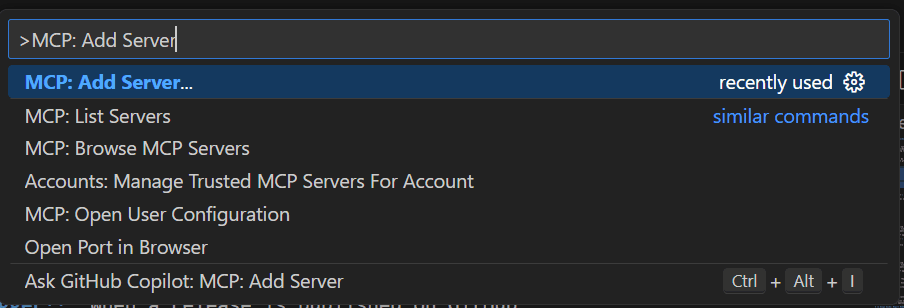
Type in: MCP: Add Server
Specify STDIO as the server type by typing STDIO and press Enter.
STDIO stands for Standard Input/Output. This is the most common and reliable server transport method.
Enter one of the commands below in the command palette to run the server.
Local JAR command:
Enter:
java -jar /full/path/to/liquibase-mcp-changelog-server-0.1.0.jar
to run the server.
Note: Ensure you replace /full/path/to/ your local path to the jar file downloaded earlier.
OR
Docker image command:
Enter:
docker run -it docker-mcp.liquibase.net/liquibase-mcp-changelog-server:0.1.0
to run the server.
Note: Ensure you have obtained the Liquibase Changelog MCP Server Docker image before using this option.
Give the server a unique name that indicates it's for Liquibase changelogs.

In this example, we use liquibase-changelog-mcp-server.
Choose your configuration scope.
Select Global to use the MCP server across all projects.
Select Workspace to use the MCP server only in the current project.
Results
Once complete, the mcp.json file will open to display your server data. Ensure that the server displayed says it is running.
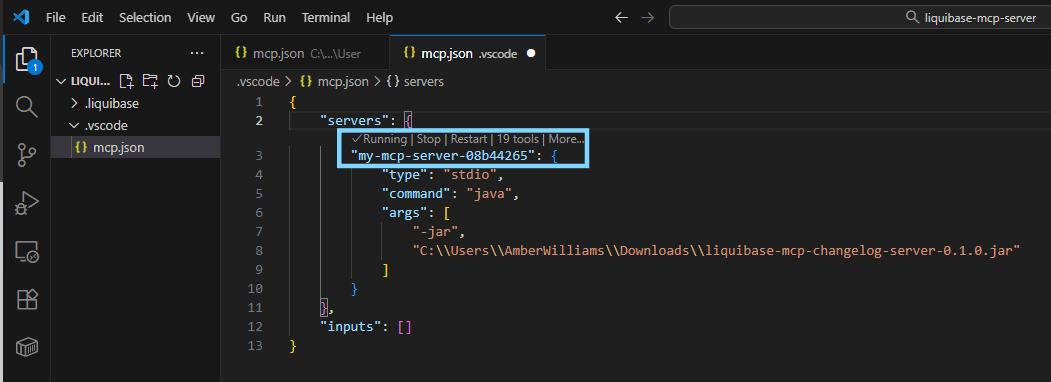
The mcp.json file displays the server data
OR:
Open the Command Palette and type in MCP: List Servers
Confirm that the liquibase-changelog-mcp-server appears and says Running in the list.
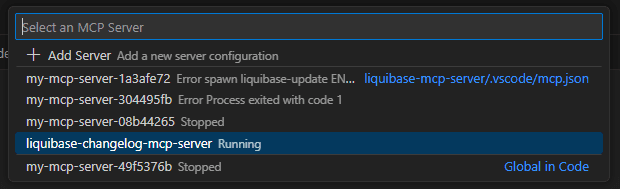
Ensure that the server you chose says Running next to it.
Next steps
The server is set up successfully and you are ready to Use the Liquibase Secure MCP Server in VS Code